
Best Earthley Alternatives for Families: Safe Picks

Table of Contents
- What Makes a Great Earthley Alternative for Families?
- Top Organic Herbal Remedies for Kids to Consider
- Comparing Family Wellness Staples: What to Look For
- Best Practices for Natural Family Wellness
- Budget-Friendly DIY Alternatives and What to Skip
- How to Transition Your Medicine Cabinet Safely
- Conclusion
- Frequently Asked Questions
Last Updated: September 23, 2026
What Makes a Great Earthley Alternative for Families?
Finding the best earthley alternatives for families starts with one question: does the label tell you everything? For parents comparing earthley alternatives, the answer usually decides the switch. At Forev'Herbs, we've watched parents spend hours in the supplement aisle trying to decode ingredient lists, and the frustration is real. The brands worth switching to share three traits: full ingredient disclosure, third-party testing, and formulas built around pediatric safety rather than adult doses scaled down.
Third-Party Testing and Ingredient Transparency
Transparency is the line between a real herbal remedy and marketing copy. Look for brands that publish full ingredient lists, name their herbal extracts specifically, and submit batches to independent labs for purity checks. A certificate of analysis, often called a COA, shows what testing found. If a company won't share one, that's your answer.
Pediatric Safety and Contraindications
Children are not small adults. Their bodies process herbal compounds differently, and some ingredients that suit a grown-up cause problems for a toddler. Raw honey is the clearest example: it should never go to a child under one year old because of infant botulism risk, a warning the CDC infant botulism guidance spells out clearly.
Top Organic Herbal Remedies for Kids to Consider
Immune Support and Respiratory Relief
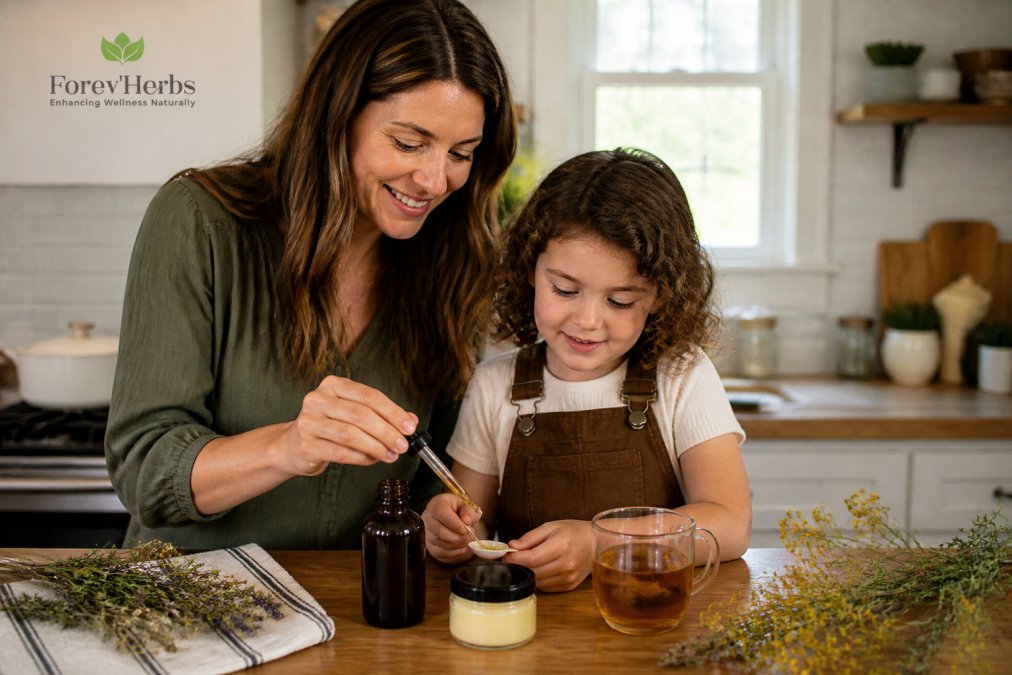
Elderberry syrup is the workhorse of cold season. A well-made syrup pairs elderberry with supporting herbs like echinacea and ginger, and it skips artificial preservatives. Forev'Herbs' Organic Elderberry Syrup follows that model with organic elderberry, echinacea, raw honey, orange peel, and Ceylon cinnamon. It's for ages one and up, and it must stay refrigerated.

Teething, Gut Health, and Topical Salves
Teething and tummy trouble are the two complaints that send parents searching for alternatives in the first place. For teething, chilled washcloths and gentle topical applications do more than most products claim. For gut health, look for simple herbal teas and probiotic-friendly foods rather than heavily sweetened gummies.
Comparing Family Wellness Staples: What to Look For
Not every product in the medicine cabinet needs replacing. The goal is to sort what actually matters from what is just marketing. The table below gives you a fast filter, and the notes underneath explain the reasoning so you can apply it to brands this article never names.
| Product Type | What to Check | Skip If | Best For |
|---|---|---|---|
| Chest rub | Petroleum-free base, age range, dilution disclosed | Contains petrolatum or undisclosed essential oils | Congestion, ages 12 and under |
| Elderberry syrup | Organic berries, no artificial preservatives, refrigerated | Contains corn syrup or artificial colors | Daily immune support |
| Eczema cream | Fragrance-free, colloidal oatmeal, short ingredient list | Heavy synthetic fragrance or parabens | Itch and dry patches |
| Herbal tea | Named herbs, caffeine-free, steeping instructions | Undisclosed blend or added sweeteners | Sore throat, congestion |
| Kids' lotion | Short ingredient list, natural preservatives | Parabens, dyes, or synthetic fragrance | Post-bath hydration |
How to Verify Purity Before You Buy
Most guides tell you to look for third-party testing but never explain how to confirm it. Here is the process that actually works. Ask the brand for a Certificate of Analysis, usually called a COA, for the specific batch you are buying. A real COA comes from an independent lab, lists the batch number, and reports results for heavy metals, microbial contamination, and sometimes pesticide residue.

Reading Labels for Pediatric Safety
Age guidance is not a suggestion. A formula labeled for ages one and up has been dosed with a toddler's body weight and liver function in mind. A formula for ages twelve and under uses lower essential oil concentrations than an adult version. When a label omits age guidance entirely, that is a signal the maker has not thought about pediatric use.
Chest Rubs, Syrups, and Teas
Chest rubs work through inhalation, so the essential oil blend is the whole point. A children's formula should be less potent than an adult version, and it should say so on the label. Syrups work from the inside, which makes the sweetener choice matter. Raw honey beats corn syrup every time, though it rules out use under age one because of infant botulism risk.
Allergy-Friendly and Gluten-Free Options
Allergy-friendly means the formula avoids the common triggers: gluten, soy, dairy, and synthetic fragrance. Botanical products have an advantage here because they rarely contain the fillers that cause reactions in the first place. Still, read the full list. "Gluten-free" on a syrup label means the thickener is not wheat-based, and that detail is worth confirming rather than assuming.
Best Practices for Natural Family Wellness
Natural family wellness works best as a routine, not a rescue. The parents who get the most from herbal products build them into daily life: a spoonful of syrup each morning through winter, a chest rub at the first sign of a cough, a cup of tea before bed. Preventative care beats symptom management every time.
Budget-Friendly DIY Alternatives and What to Skip
Some remedies you can make at home for less. Others you should buy, because getting them wrong is worse than paying for them. The line between the two is not about difficulty. It is about whether a mistake can harm your child.
Worth making yourself:
- Chilled washcloths for teething, which cost nothing and work as well as most teething gels
- Honey and lemon in warm water for children over age one, for sore throats and coughs
- Oatmeal baths for itchy skin, using plain rolled oats blended fine and stirred into lukewarm water
- Saline drops for stuffy noses, which you can mix at home with salt and cooled boiled water
- A simple chest compress using a warm, damp cloth, which helps congestion without any essential oils
Worth buying:
- Elderberry syrup, because proper extraction and preservation take equipment and a refrigerator commitment
- Chest rubs, because essential oil dilution for children requires precision that eyeballing cannot deliver
- Eczema creams, because stable emulsions need emulsifying wax and preservatives to stay safe over time
- Probiotic blends, because live cultures need controlled storage conditions
Storage and Shelf Life for Homemade Remedies
Anything you make at home has a shorter shelf life than a commercial product. Oatmeal baths should be used the same day. Saline drops last about a week in the refrigerator. Honey and lemon mixtures should be made fresh each time. Label everything with the date you made it, and when in doubt, throw it out. The cost of replacing a batch is always lower than the cost of a sick child.
When to Skip DIY Entirely
If your child has a chronic condition, takes prescription medication, or is under age one, talk to your pediatrician before trying any homemade remedy. The same goes for anything involving essential oils, which are concentrated and can be dangerous when diluted incorrectly. A pediatrician can tell you whether a remedy is appropriate for your child's specific situation, and that guidance is worth more than any recipe.
How to Transition Your Medicine Cabinet Safely
Switching products takes a weekend and a bit of patience. Start by clearing out anything expired, then read the labels on what remains. Anything with undisclosed ingredients or petroleum-based bases goes in the discard pile.
Conclusion
Building a natural medicine cabinet takes more judgment than the labels suggest. The brands worth your money prove their testing, disclose their ingredients, and give clear age guidance. That's the standard, and it's not a high bar to clear.
Frequently Asked Questions
Are Earthley products good for families?
Earthley products are popular for their natural ingredients, but families should verify third-party testing and pediatric safety. Many parents seek Earthley alternatives that offer transparent sourcing and clear dosage guidelines. Look for brands that list every ingredient, provide batch testing, and offer alcohol-free or honey-free options for young children. Always check with a pediatrician before starting any herbal remedy, especially for kids under two.
What should I look for in organic herbal remedies for kids?
Prioritize organic certification, third-party lab testing, and age-appropriate formulations. Avoid products with alcohol, artificial preservatives, or high-dose essential oils for young children. Check for clear dosing instructions by age and weight. Honey-based syrups are unsafe for infants under one year. Look for brands that disclose their sourcing and provide a certificate of analysis. A pediatrician-approved guideline helps ensure safety alongside efficacy.
How do I choose safe herbal supplements for children?
Start by checking the label for a complete ingredient list and a manufacturer contact. Choose products tested by independent labs for purity and potency. Avoid blends with multiple herbs unless a healthcare provider approves. For children, single-herb products with clear dosing are easier to monitor. Be aware of potential drug interactions, especially if your child takes prescription medication. Introduce one new supplement at a time to watch for reactions.
What are the benefits of using botanical-based family wellness products?
Botanical-based products often use plant extracts, essential oils, and natural carriers like castor wax instead of petroleum. This can mean fewer synthetic chemicals and less skin irritation for sensitive children. Many families report that natural chest rubs and salves feel gentler and absorb well. However, natural does not automatically mean safe for everyone. Always patch-test topical products and consult a pediatrician for internal remedies. Look for non-toxic, allergy-friendly options.
How do I transition to a more natural medicine cabinet?
Replace one product at a time, starting with items your family uses most, like chest rubs or lotions. Read labels and avoid petroleum jelly, synthetic fragrances, and alcohol in children's remedies. Stock organic elderberry syrup, herbal teas, and gentle salves. Keep emergency medications on hand. Track what works and what does not. Consult a pediatrician before removing any prescribed treatment. A gradual switch reduces waste and lets you monitor each change.