
Best Natural Skincare for Sensitive Skin

Table of Contents
- What Makes Skincare Safe for Sensitive Skin
- Natural Ingredients for Sensitive Skin That Actually Help
- Top Picks: Best Natural Skincare for Sensitive Skin
- How to Build a Natural Skincare Routine for Sensitive Skin
- Best Natural Face Wash for Sensitive Skin
- How to Patch Test and Transition Safely
- Conclusion
- Frequently Asked Questions
Last Updated: September 13, 2026
What Makes Skincare Safe for Sensitive Skin
Sensitive skin is a condition where the skin's protective outer layer reacts to ingredients, weather, or friction that other skin types tolerate. This guide from Forev'Herbs breaks down which natural skincare ingredients help, which to avoid, and which products suit reactive, eczema-prone skin.
The difference between a product that soothes and one that stings comes down to one factor: whether it supports the skin barrier or strips it.
According to the American Academy of Dermatology's guidance on sensitive skin, people with sensitive skin should look for products with few ingredients and no added fragrance, since fragrance is one of the most common triggers of contact irritation.
The Skin Barrier and Why It Matters
The skin barrier is the outermost layer of skin, made of skin cells bound by lipids and ceramides that hold in water and keep irritants out (Skin Barrier Function: The Interplay of Physical, Chemical, and Immunologic Properties). When it is compromised, moisture escapes through trans-epidermal water loss, and everyday ingredients cause redness, stinging, and inflammation.
A common mistake is treating sensitivity as a skin type rather than a barrier problem. The fix is not "find gentler products forever", it is rebuild the barrier so your skin tolerates more. Ceramides, glycerin, and linoleic-rich oils like jojoba and rosehip support that repair.
Natural Ingredients for Sensitive Skin That Actually Help
The most reliable natural ingredients for sensitive skin mimic the skin's own lipids or calm inflammation without added fragrance. Look for these on a label:
- Ceramides and glycerin to restore moisture and reduce water loss
- Aloe vera, chamomile, and calendula for soothing redness and irritation
- Jojoba and rosehip oil for linoleic-rich, non-comedogenic hydration
- Colloidal oatmeal to ease itchiness on reactive skin
- Shea butter and sea buckthorn to nourish a dry, compromised barrier
What most guides miss: "botanical" does not automatically mean gentle. Some plant extracts are excellent; others are irritants in disguise.
Ingredients to Avoid
Skip these if your skin is reactive: synthetic fragrance, high-concentration essential oils, sulfates, parabens, drying alcohols, and rough physical scrubs. Fragrance-free and essential oil-free formulas are the safest starting point, and "hypoallergenic" and "dermatologist-tested" labels are worth prioritizing, though neither is a guarantee.
Top Picks: Best Natural Skincare for Sensitive Skin
The best natural skincare for sensitive skin pairs a short ingredient list with barrier-supporting botanicals, and every product below is unscented or fragrance-free by design. Forev'Herbs makes each one in small batches, covering cleansing, moisturizing, and targeted relief for eczema-prone skin.
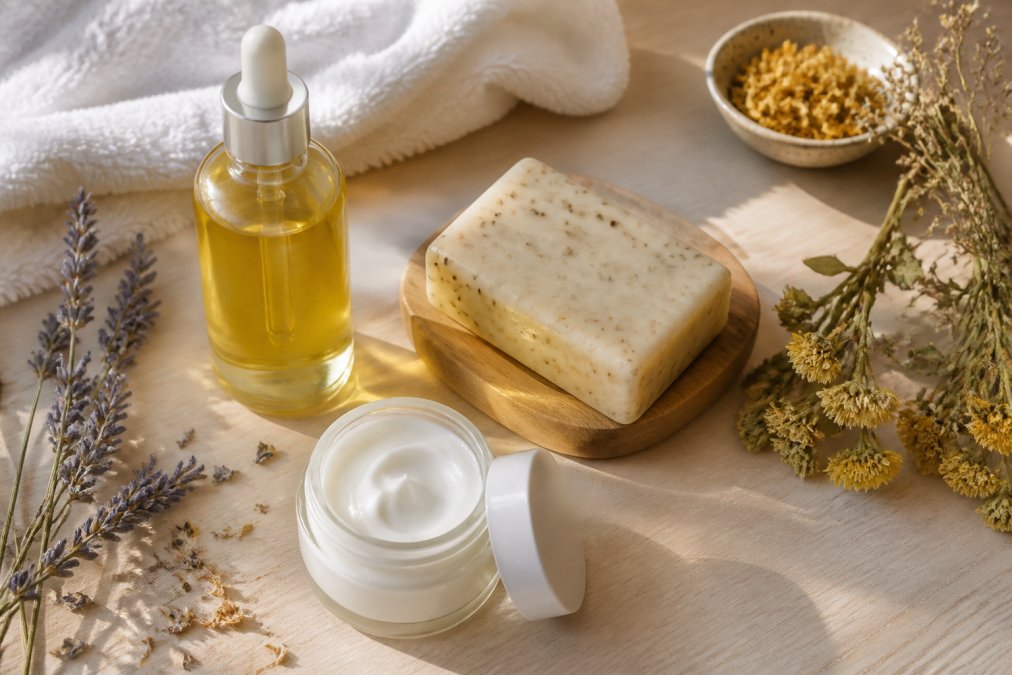
| Product | Price | Best For | Key Ingredients |
|---|---|---|---|
| Sensitive & Dry Skin Body Oil | $19.99 | Daily hydration | Kukui, sweet almond, sunflower |
| Eczema Cream | $15.99 | Eczema flare-ups | Shea, calendula, colloidal oatmeal |
| Unscented Castile Goat Milk Soap | $6.75 | Reactive, delicate skin | Goat milk, olive oil |
| Unscented Oatmeal Soap | $6.75 | Dry, itchy skin | Goat milk, oatmeal, shea |
| Unscented Shea Soap | $6.75 | Everyday cleansing | Shea butter, olive oil |
Sensitive & Dry Skin Body Oil
The best pick for daily hydration on delicate skin. Kukui, organic sweet almond, sunflower, hazelnut, and castor oils sink in without a greasy finish, and kukui oil's fatty acids help restore the skin barrier.


Eczema Cream
For itch relief on dry, eczema-prone skin, this is a rich formula. Shea and mango butters seal in moisture, while calendula-infused olive oil, tamanu oil, and colloidal oatmeal calm irritation.
Unscented Castile Goat Milk Handmade Soap
A gentle cleanser for reactive skin. Goat milk's moisturizing properties combine with mild Castile soap to clean without stripping, and the formula is pH-balanced to maintain the skin's natural acid mantle. Best for anyone who finds standard bar soap too drying.
Unscented Oatmeal Handmade Soap
This bar adds gentle exfoliation to the goat milk base. Colloidal oatmeal eases itchiness, making it a good fit for dry, flaky body patches. The oatmeal texture is subtle, so do not expect a scrub.
Unscented Shea Handmade Soap
The simplest bar of the three, crafted with bare ingredients featuring shea butter. Free from any added fragrance or coloring, this soap is perfect for sensitive skin or those who prefer an uncomplicated cleanse.
How to Build a Natural Skincare Routine for Sensitive Skin
A sensitive-skin routine works best when it stays short: cleanse, moisturize, protect, repeat. Adding products one at a time lets you identify what actually helps. The goal is not a ten-step regimen but a repeatable sequence your barrier can predict, predictability is what stops reactivity.
The Four-Step Core
- Cleanse. Lukewarm water only in the morning for most reactive skin; an unscented, sulfate-free bar or cream cleanser at night. Hot water strips lipids and is one of the most underrated triggers of redness.
- Treat (optional). A single targeted product, a barrier serum, a calming cream, or a spot treatment for eczema patches. Never stack two actives at once.
- Moisturize. Apply to damp skin within about a minute of patting dry. This is when humectants like glycerin pull water in rather than sitting on top of dry skin.
- Protect. A mineral sunscreen with zinc oxide or titanium dioxide in the morning. Chemical filters are not inherently bad, but mineral formulas are the safer default for reactive skin because they sit on top of the barrier rather than penetrating it.
Order matters less than consistency, but one rule is non-negotiable: thinnest texture first, thickest last. A body oil over a cream will not absorb; a cream over an oil will pill.
Morning vs. Evening
- Morning: rinse, moisturizer, sunscreen. That is the whole routine for most people.
- Evening: cleanse, treat if needed, moisturize. Evening is when you remove the day's buildup, sunscreen residue, pollution particles, sweat, so cleansing matters more here than in the morning.
The Microbiome Angle Most Guides Skip
The skin has its own ecosystem of bacteria, fungi, and yeasts that help keep pathogens in check. Harsh cleansers, antibacterial soaps, and high-concentration essential oils can wipe out that ecosystem along with the irritants, one reason some people feel their skin gets more reactive the more aggressively they cleanse. For sensitive skin, favor mild surfactants, avoid antibacterial formulas unless a doctor recommends one, and skip the urge to "sterilize" your face. A short, gentle routine does more for the microbiome than any probiotic serum.
Environmental Triggers to Account For
Your routine is not the only variable. Three environmental factors routinely drive sensitivity:
- Hard water. Minerals in hard water leave a residue that disrupts the barrier and can make cleansers feel like they never rinse clean. If your skin stings after washing, a shower filter or a final rinse with filtered or distilled water is worth testing.
- Pollution. Particulate matter and ozone generate free radicals on the skin surface. Antioxidant-rich oils like rosehip and sea buckthorn help, and cleansing at night matters more in urban environments.
- Climate swings. Cold, low-humidity air pulls water out of the barrier; dry indoor heat does the same. A humidifier in winter and a heavier occlusive at night are simple, cheap fixes.
A Sample Week
- Days 1-7: cleanse and moisturize only. No exfoliation, no new products.
- Days 8-14: add sunscreen in the morning if you were not already using one.
- Days 15-21: add one targeted product, a calming cream or barrier oil, and use it every other night.
- Day 22 onward: if skin is calm, keep the routine as is. If it is not, remove the last product added and hold for a week.
Best Natural Face Wash for Sensitive Skin
The best natural face wash for sensitive skin is an unscented, sulfate-free bar or cream cleanser that removes dirt without stripping the barrier. For most people, that means avoiding foaming gels and choosing something mild enough for twice-daily use.
Forev'Herbs' Unscented Castile Goat Milk Soap and Unscented Shea Soap both work as facial cleansers because they contain no fragrance or essential oils. Use lukewarm water, lather in your hands rather than on your face, and follow immediately with moisturizer while skin is still damp.
How to Patch Test and Transition Safely
Patch testing is the only reliable way to know whether a new product suits your skin before you commit. Test one product at a time, giving each several days before adding the next, if you introduce three products in a week and react, you cannot tell which one caused it.
The Standard Patch Test
- Apply a small amount to your inner forearm or behind your ear
- Wait 24 to 48 hours and check for redness, itching, or swelling
- If clear, test on a small area of your face or the affected patch
- Introduce one new product per week, never several at once
- Stop immediately if irritation appears, and note the ingredient
Irritation vs. Allergy, Why the Distinction Matters
Most reactions to skincare are irritant contact dermatitis, not true allergy. Irritant reactions are dose-dependent: a small amount may be fine, while a larger amount or repeated use causes redness and stinging (Contact Dermatitis). They usually appear within minutes to hours and fade once you stop using the product. True allergic contact dermatitis is immune-mediated, can take 24 to 72 hours to appear, and may worsen with each exposure. If a reaction spreads beyond the application site, or you have swelling, blistering, or difficulty breathing, stop use and seek medical care. For persistent reactions, a dermatologist can patch test with a standardized panel to identify the allergen.
If You Have a Professional Procedure Scheduled
Sensitive skin and in-office treatments are not mutually exclusive, but the recovery window needs a gentler routine. After a chemical peel, laser session, or microneedling, most practitioners recommend pausing all exfoliants, retinoids, and fragrance for at least five to seven days. During that window, stick to a bland cleanser, a simple moisturizer, and mineral sunscreen. Once peeling or flaking stops, reintroduce one product at a time using the one-per-week rule above. Ask your provider for a specific timeline, it varies by treatment depth and your skin's response.
The Inside-Out Factors Nobody Tests For
A product can pass a patch test and still cause a flare, because skin sensitivity is not only topical. Three internal triggers are worth tracking:
- Diet. For some people, high-histamine foods, alcohol, and spicy food correlate with flushing and itching. A simple food-and-symptom log for two weeks often reveals a pattern that no ingredient label would show.
- Stress. Elevated cortisol is linked to impaired barrier recovery and increased inflammation. Flare-ups that line up with high-stress weeks are common and not a coincidence.
- Gut health. The gut-skin axis is an active area of research, and while the science is still developing, many people with reactive skin notice improvement when they address digestive issues with a clinician. This is not a reason to buy a probiotic serum, it is a reason to mention persistent skin issues to your doctor.
Transitioning From a Conventional Routine
If you are switching from a conventional routine, expect a transition period of a week or two. Your skin may feel drier at first as it adjusts to the absence of synthetic fillers and occlusives. Do not add more products, add one heavier moisturizer at night and give the barrier time to catch up.
Conclusion
Building a routine around sensitive skin takes patience, and the trial-and-error phase is where most people give up. Forev'Herbs makes that process simpler with short ingredient lists, unscented formulas, and botanicals chosen for reactive skin: the Eczema Cream for flare-ups, the Sensitive & Dry Skin Body Oil for daily hydration, and three unscented handmade soaps for gentle cleansing. Every product is made in small batches by a Silver Certified Natural Business. Search products at Forev'Herbs and start with one product at a time.
Frequently Asked Questions
What is the best skincare for extremely sensitive skin?
Extremely sensitive skin benefits from fragrance-free, hypoallergenic products with minimal ingredients. Look for items with ceramides, glycerin, or colloidal oatmeal to support the skin barrier. Avoid essential oils, sulfates, and parabens. A gentle cleanser like an unscented Castile goat milk soap followed by a rich moisturizer or body oil can reduce redness and irritation. Always patch test new products on a small area first.
Which natural ingredients are safest for sensitive skin?
Safest natural ingredients for sensitive skin include aloe vera, chamomile, calendula, jojoba oil, rosehip oil, sea buckthorn, and colloidal oatmeal. These are known for their soothing, anti-inflammatory, and barrier-supporting properties. Also look for linoleic-rich oils like sunflower and safflower, plus ceramides and glycerin. Avoid essential oils, fragrance, and exfoliating acids, which can trigger reactivity in sensitive skin types.
How do I transition to natural skincare if I have sensitive skin?
Transition gradually by introducing one new product at a time, waiting 3-5 days between additions. Start with a gentle cleanser and moisturizer, then add treatments. Patch test each product on your inner forearm for 24-48 hours before applying to your face. Keep a diary of reactions. If irritation occurs, stop use and return to your previous routine. This slow approach helps you identify which ingredients work for your skin without overwhelming it.
What ingredients should sensitive skin types avoid in natural products?
Even natural products can irritate sensitive skin. Avoid essential oils (like citrus, peppermint, eucalyptus), alcohol denat, harsh exfoliants (walnut scrub, baking soda), and high concentrations of vitamin C or retinol. Also skip synthetic fragrances, parabens, sulfates, and phthalates. Look for fragrance-free, non-comedogenic, and dermatologist-tested labels. When in doubt, choose products with short ingredient lists and no added scent.
Are organic skincare products better for sensitive skin?
Certified organic products can be better for sensitive skin because they avoid synthetic pesticides and fertilizers, reducing potential irritants. However, organic doesn't automatically mean non-irritating; essential oils and botanicals can still cause reactions. Focus on products labeled fragrance-free, hypoallergenic, and non-comedogenic, and check for third-party certifications. Organic is a good starting point, but patch testing remains essential for sensitive skin.