
Is Herbal Cough Syrup Safe for Babies? A Parent's Guide

Table of Contents
- Why OTC Cough Syrups Are Not Safe for Babies
- When Can Babies Have Honey for Cough?
- Herbal Cough Syrup for Babies: What You Need to Know
- How to Use Elderberry Syrup for Toddlers Safely
- Natural Home Remedies for Baby Coughs
- When to Call a Pediatrician
- Frequently Asked Questions
Last Updated: September 16, 2026
Why OTC Cough Syrups Are Not Safe for Babies
The short answer: over-the-counter cough syrups are not safe for babies, and no major health authority recommends them for children under two. This guide from Forev'Herbs walks through what the research says, where the real risks sit, and which natural options actually work.
FDA Warnings on Over-the-Counter Medications
The FDA has warned for years that OTC cough and cold products can cause serious side effects in infants, including rapid heart rate, drowsiness, and, in rare cases, death. Ingredients like dextromethorphan, diphenhydramine, and phenylephrine are common in these formulas, and none are approved for infants. The FDA guidance on using cough and cold medicines in children states that these products should not be used in children under two at all.
When Can Babies Have Honey for Cough?
Honey is safe for children over 12 months old, but never for babies under one. This is the single most important age rule in home cough care, and it comes down to infant botulism.
The Real Danger of Infant Botulism
Infant botulism is a rare but serious illness caused by Clostridium botulinum spores, which can grow in an infant's immature digestive tract. Honey is a known source of these spores. According to the CDC information on infant botulism and honey, honey should not be given to any child under 12 months, even in cooked or baked form.
Herbal Cough Syrup for Babies: What You Need to Know
No herbal cough syrup is automatically safe for babies just because it is plant-based. Herbal cough syrup for babies carries the same core risk as conventional syrup: ingredients that a young immune and nervous system cannot process. Some botanicals are genuinely gentle; others are toxic at small doses. A common mistake is treating "natural" as a synonym for "safe." It is not.
Why "Herbal" Is Not a Safety Category
Herbal products are regulated as dietary supplements, not as drugs. That means they are not required to prove efficacy or pediatric safety before they reach the shelf, and dosing for infants is rarely established. A botanical that is mild for an adult can be a different substance entirely for a six-month-old, whose liver and kidneys clear compounds more slowly and whose blood-brain barrier is still maturing.
How to Read a Cough Syrup Label Like a Clinician
Most parents scan the front of the bottle. The information that matters is on the back, and it is worth reading in a fixed order every time.
- Find the "Drug Facts" panel first. If a product has one, it is regulated as a drug and its active ingredients are listed with amounts. If there is no Drug Facts panel and only a "Supplement Facts" panel, the product is a supplement, which means the ingredient amounts may be vague and pediatric dosing is likely unestablished.
- Check the age statement, not the word "children's." "Children's" is a marketing term, not a safety threshold. Look for an explicit age floor such as "children 4 years and older" or "do not use under 2." If no age is stated, treat the product as unrated for an infant.
- Scan the active ingredients for the three problem classes. Decongestants (phenylephrine, pseudoephedrine), antihistamines (diphenhydramine, brompheniramine, chlorpheniramine), and cough suppressants (dextromethorphan) are the ingredients regulators have flagged for young children. None are appropriate for an infant without a clinician's direction.
- Read the inactive ingredients for alcohol and sweeteners. Alcohol as a base is never appropriate for an infant. Honey or honey solids in the ingredient list rule the product out for anyone under 12 months because of the botulism risk.
- Distrust vague quantities. "Proprietary blend," "herbal complex," or a list of botanicals with no milligram amounts means you cannot know the dose. Unknown dose plus immature metabolism is the exact combination to avoid.
- Look for a batch or lot number and a manufacturer address. A product that will not tell you who made it and when is not one to give a baby.
Ingredients to Avoid on the Label
Read every label for these, and put the bottle back if you see them:
- Camphor in high concentrations: can cause seizures if swallowed
- Eucalyptus oil taken internally: toxic to infants
- Menthol in strong doses: can trigger breathing problems in very young children
- Ephedra, comfrey, and coltsfoot: linked to serious liver and heart effects
- Alcohol as a base: never appropriate for an infant
- Honey or honey solids: unsafe under 12 months
The Takeaway for Parents
Ingredient label literacy is your best defense, and it takes about thirty seconds once you know the order to read in. If a syrup fails any of the six checks above, it is not a candidate for an infant, no matter how the front of the bottle is worded.
How to Use Elderberry Syrup for Toddlers Safely
Elderberry syrup is generally used for children over one year old, in small, age-appropriate servings, and only as a supportive remedy, not a treatment. How to use elderberry syrup for toddlers safely comes down to three things: age, dose, and a clean ingredient list.
| Age Group | Elderberry Syrup | Honey | OTC Cough Syrup |
|---|---|---|---|
| Under 12 months | Not recommended | Never | Never |
| 12-24 months | Only with pediatrician guidance | Safe in small amounts | Never without a doctor |
| 2 years and older | Follow label, small servings | Safe | Only as directed by a doctor |
Natural Home Remedies for Baby Coughs
For babies under one, the safest cough relief is drug-free. Hydration, saline drops, nasal suction, and a cool-mist humidifier do more than most parents expect, and they carry no medication risk.
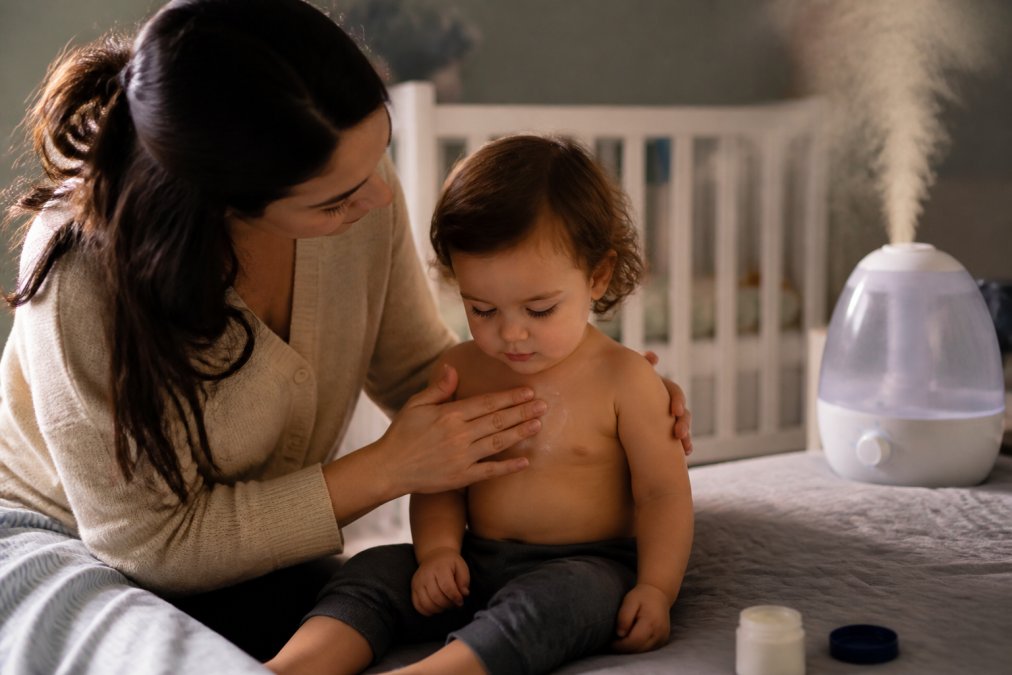
Saline Drops, Nasal Suction, and Humidifiers
Used together, these three tools handle most infant congestion:
- Saline drops loosen dried mucus in the nasal passages.
- Nasal suction clears the loosened mucus so the baby can breathe and feed.
- A cool-mist humidifier keeps the air moist overnight, thinning mucus and calming irritated airways.
Environmental factors matter here. Smoke, strong fragrances, and dry heated air all aggravate a cough, so keep the nursery clean and the air gentle.
When to Call a Pediatrician
Knowing when to call is as important as knowing what to give, and for infants, the threshold is lower than most parents expect. The guidance below separates true emergencies from same-day calls and from watch-and-wait situations, so you can act with proportion instead of panic.
Call 911 or Go to the Emergency Room Now
These signs mean a baby may not be moving enough air, and they need emergency care, not a home remedy or a callback:
- Difficulty breathing, nostrils flaring, ribs or the notch above the breastbone pulling in with each breath (retractions), or grunting at the end of each exhale
- A blue or gray tint around the lips, tongue, or face
- Pauses in breathing or a baby who is limp, unresponsive, or hard to wake
- Stridor, a harsh, high-pitched sound on the inhale that you can hear across the room, which can signal a narrowed airway
- Choking or gagging with a cough that started suddenly, especially after eating or playing with small objects
Call the Pediatrician the Same Day
- Any cough in a baby under 3 months old, at this age, a cough is never routine and warrants a same-day assessment
- A fever in an infant under 3 months, or a high fever at any infant age
- Fast or labored breathing without the emergency signs above
- A cough paired with wheezing, vomiting after coughing fits, or unusual sleepiness
- Refusing to feed, fewer wet diapers, or signs of dehydration
- A cough that lasts more than a few days, gets steadily worse, or comes in severe fits
Know the Cough Type Before You Call
Describing the cough accurately helps the office triage your baby faster. Three patterns matter most:
- Wet (productive) cough, you hear mucus rattling in the chest. Common with colds and usually managed with fluids, saline, and suction. Call if it persists or breathing becomes labored.
- Dry cough, no mucus, often a tickle or irritation. Frequently follows a viral illness and can linger for a week or two. Call if it disrupts sleep and feeding or lasts beyond a couple of weeks.
- Croup-like cough, a barking, seal-like cough, often worse at night, sometimes with a hoarse cry or the stridor described above. Croup can narrow a small airway quickly, so call the same day, and go to the emergency room if breathing becomes labored or the baby turns blue.
What to Have Ready When You Call
A short, factual summary speeds up the advice you get. Jot down:
- Your baby's age and weight
- When the cough started and how it has changed
- Whether there is fever, and the highest reading
- Feeding and diaper counts for the last 24 hours
- Any medications or remedies already given, with amounts and times
- Any known exposures to sick contacts
The Bottom Line on Timing
For infants, the safe default is to call early and call often. A cough in a newborn, any trouble breathing, or any change in alertness or feeding is a reason to reach out the same day. Home remedies are for comfort; they are not a substitute for an assessment when the signs above appear.
Frequently Asked Questions
What are some natural cough syrups safe for babies?
No herbal cough syrup is universally safe for babies under 12 months without a pediatrician's approval. For infants, the safest approach is drug-free relief: saline drops, nasal suction, a cool-mist humidifier, and plenty of fluids. For toddlers over 12 months, a small amount of honey can soothe a cough. Always check with your pediatrician before giving any herbal cough syrup to a baby, and read labels carefully to avoid toxic ingredients like dextromethorphan, promethazine, or diphenhydramine.
Can a 6-month-old have cough syrup?
No. The FDA strongly advises against giving over-the-counter cough syrup to children under 2 years old, and that includes 6-month-olds. Cough syrups can cause serious side effects in infants, including respiratory distress, sedation, and airway obstruction. Instead, use saline drops, nasal suction, and a humidifier to ease congestion. If your 6-month-old has a persistent cough, fever, or trouble breathing, call your pediatrician right away.
What ingredients should I avoid in baby cough medicine?
Avoid any cough syrup containing dextromethorphan, phenylephrine, promethazine, diphenhydramine, or alcohol. These ingredients can cause dangerous side effects in infants, including sedation, rapid heart rate, and respiratory distress. Also steer clear of honey in children under 12 months due to the risk of infant botulism. Read every label carefully, and if you see an ingredient you do not recognize, ask your pediatrician before giving it to your baby.
How do I use elderberry syrup for toddlers safely?
Elderberry syrup is not recommended for babies under 12 months. For toddlers over 1 year, follow the dosage on the product label or ask your pediatrician for guidance. Start with a small amount to check for allergic reactions. Never give elderberry syrup to a child who is already taking other medications without checking for interactions. If your toddler has a fever, difficulty breathing, or a cough that lasts more than a few days, see a pediatrician.