
Petroleum-Free Balms for Babies: 6 Natural Options

Table of Contents
- Why Parents Choose Petroleum-Free Balms for Babies
- What Makes a Natural Baby Balm Different
- Baby Balm Ingredients to Avoid
- Petroleum-Free Balms for Sensitive Skin
- Natural Diaper Rash Cream and Multi-Use Options
- How to Choose the Right Balm for Your Child
- Frequently Asked Questions
Last Updated: October 13, 2026
Why Parents Choose Petroleum-Free Balms for Babies
Many parents are switching to petroleum free balms for babies that use natural ingredients instead of petroleum jelly. The shift makes sense once you understand what petroleum jelly does, and doesn't do, for delicate baby skin.
Petroleum jelly forms an occlusive barrier that traps moisture but also dirt, bacteria, and sweat. For babies with sensitive skin or eczema, this can worsen irritation. Natural petroleum-free balms absorb instead, nourishing skin with botanical ingredients and letting it breathe.
Parents switch for three reasons: safety concerns about petroleum derivatives, a preference for recognizable plant-based ingredients, and better results on their baby's specific skin issues. Whether your baby has cradle cap, diaper rash, dry patches, or winter dryness, petroleum-free alternatives can be a good choice.
Below: what makes natural baby balms different, which ingredients work, and how to pick one.
What Makes a Natural Baby Balm Different
The core difference is how each interacts with skin. Petroleum jelly sits on top and creates a waterproof seal; natural balms contain oils and butters that absorb and nourish the skin barrier itself.
Natural balms typically combine plant oils (castor, jojoba, olive) with botanical butters (shea, mango) and sometimes healing ingredients like calendula, tamanu oil, or colloidal oatmeal. These moisturize and can be soothing.
One key advantage is breathability: because natural balms absorb rather than seal, they may not trap heat or moisture against skin the way petroleum products can.
Natural balms also tend to be fragrance-free or scented only with essential oils, avoiding synthetic fragrances that irritate sensitive baby skin, so you can recognize what you're putting on your child.
Baby Balm Ingredients to Avoid
Most "ingredients to avoid" lists recycle the same warnings. The useful skill is reading a label the way a formulator does, so you can spot petroleum-derived materials hiding behind unfamiliar names.
How to tell whether an ingredient is petroleum-derived
"Petroleum-free" is not a regulated claim, so the practical test is the ingredient list. These names indicate petroleum-derived or petroleum-adjacent materials:
- Petrolatum, petroleum jelly, white petrolatum, mineral oil, paraffin, microcrystalline wax, ozokerite, ceresin, all refined from crude oil.
- PEG compounds (e.g., PEG-100 stearate, PEG-8) and ceteareth or steareth followed by a number, these are petrochemical-derived emulsifiers and thickeners.
- Butylene glycol, propylene glycol, and petrolatum-based emollients, synthesized from petrochemical feedstocks, not plants.
- Isohexadecane, isododecane, and similar "iso-" and "-ane" names, synthetic hydrocarbons.
If a label says "plant-based" but lists several of these, the claim is doing more work than the formula.
Ingredients worth a second look (and why)
- Synthetic fragrance and "parfum", an umbrella term hiding dozens of undeclared compounds, and a common trigger of contact irritation in babies. Fragrance-free is the safer default for newborns.
- Essential oils, natural but not automatically gentle. Avoid menthol, camphor, eucalyptus, and high-concentration citrus on infants; even lavender and chamomile can sensitize some babies.
- Parabens (methylparaben, propylparaben), preservatives many parents skip, though evidence on low-dose exposure is debated.
- Phenoxyethanol, regulators consider it safe at cosmetic concentrations; the "neurotoxin" framing refers to high-dose studies, not typical leave-on use.
- Lanolin, from sheep's wool; generally well tolerated but a known allergen for a small share of babies.
- Talc, a powder concern mainly when inhaled; not relevant to a balm.
What actually matters more than the avoid-list
A short ingredient list isn't automatically safer, nor a long one worse, preservatives and emulsifiers exist for a reason, and an unpreserved balm can grow mold. Better questions: Does the formula disclose every ingredient? Is the fragrance source named? Is the preservative system appropriate for a water-containing product? An oil-and-wax balm with no water needs little preservation, which is why many petroleum-free balms run short lists naturally.
Petroleum-Free Balms for Sensitive Skin
Babies with sensitive skin or eczema need balms that soothe without triggering new irritation, where petroleum-free formulas shine.
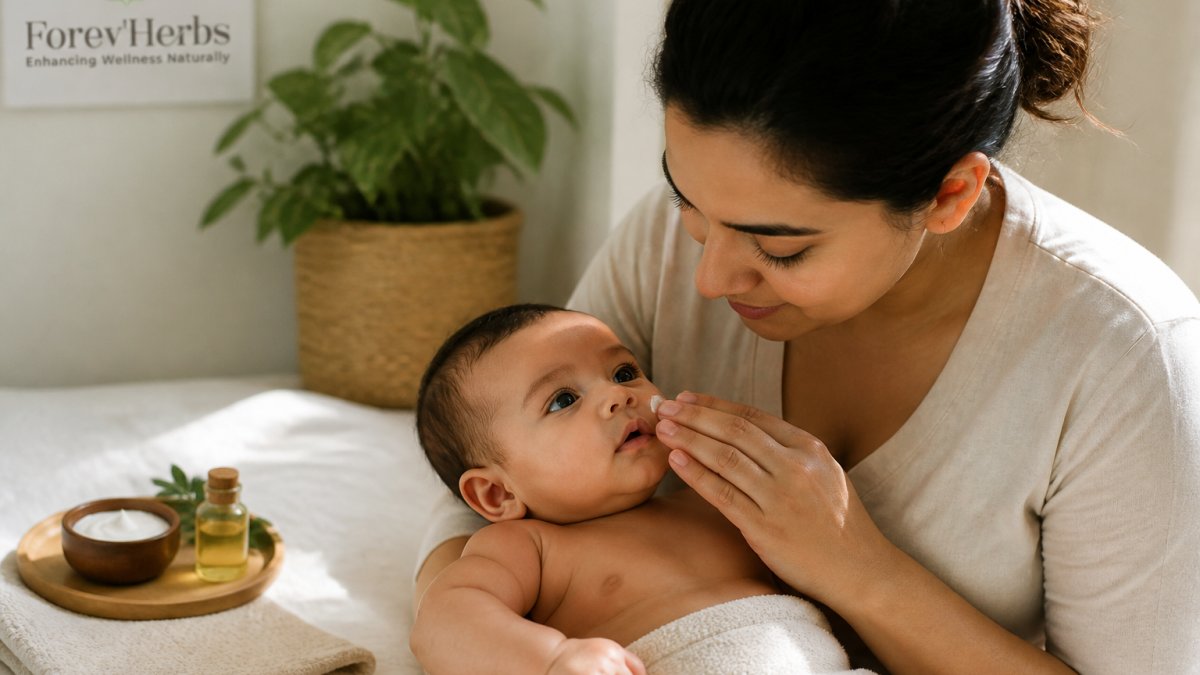
Look for colloidal oatmeal, a finely ground oat powder that reduces inflammation and itching, and zinc oxide, a mineral-based ingredient that creates a gentle protective layer.
Tamanu oil has a long history in traditional medicine for skin repair and is particularly effective for eczema, reducing redness and supporting the skin barrier. Its earthy scent signals a real, active ingredient.
Shea and mango butter provide deep hydration without petroleum's occlusive feel, rich enough for very dry skin but absorbing completely, so your baby won't feel greasy.
Calendula-infused oils calm irritation and promote healing, and are gentle enough even for newborns.
For sensitive-skin relief, Forev'Herbs Eczema Cream combines shea butter, mango butter, calendula-infused olive oil, castor oil, tamanu oil, jojoba oil, zinc oxide, colloidal oatmeal, vitamin E, arrowroot, and rosemary extract.

Natural Diaper Rash Cream and Multi-Use Options
Diaper rash is the most common reason parents reach for a balm, and where "natural" advice most often goes wrong, because not every red bottom is the same problem and a barrier balm isn't a treatment for all of them.
Everyday barrier care vs. a rash that needs more
Most diaper irritation is contact dermatitis: skin stays wet or in contact with urine, feces, or detergent residue, and the outer layer breaks down. A barrier balm at every change is the right tool, the goal is keeping urine and stool off the skin, not "healing" anything.
A smaller share are yeast (candida) rashes: beefy-red patches with satellite bumps at the edges, often in skin creases, frequently following antibiotics or diarrhea. Barrier balms don't treat yeast; these need an antifungal, which is a clinician's call.
Signs to contact a pediatric clinician rather than self-treat:
- Rash that is not improving after 2-3 days of consistent barrier care.
- Blisters, pus, open weeping sores, or skin that looks broken down.
- Rash spreading beyond the diaper area, or accompanied by fever.
- A baby under 6 weeks old with any rash.
- Rash that keeps returning immediately after it clears.
What to look for in a diaper balm
- Zinc oxide, the most studied barrier ingredient; stays on skin, blocks moisture, mildly astringent. Higher percentages are thicker and more protective; lower ones spread easily for daily use.
- Petrolatum, the traditional barrier. If avoiding petroleum, plant waxes and butters (beeswax, candelilla, shea, mango) plus zinc oxide approximate the same film.
- Colloidal oatmeal, soothes itch and inflammation; useful for irritated but unbroken skin.
- Castor oil and other plant oils, emollients that soften skin but don't replace a barrier ingredient.
A practical routine: change frequently, pat (don't rub) dry, apply a thick layer of balm at every change, and air out the diaper area when you can. Thick application matters more than brand.
Multi-use: what one balm can and cannot do
A petroleum-free balm can reasonably cover several jobs, but not all of them equally well:
| Use case | Ingredient that does the work | Notes |
|---|---|---|
| Diaper area | Zinc oxide + wax/butter | Needs to stay put through wetness |
| Cheeks and face | Shea or mango butter | Lighter, absorbs, safe near eyes |
| Chapped lips | Beeswax or candelilla wax | Occlusive film, tiny amount |
| Cradle cap | Plant oil (olive, jojoba) | Loosen flakes, then gentle wash |
| Dry patches / eczema | Colloidal oatmeal, tamanu oil | Soothing, barrier-supporting |
A single formula rarely excels at all five: a high-zinc diaper balm is too thick and white for cheeks, while a light facial butter is too thin for a wet diaper. Most parents end up with two products, one for the diaper area, one for everywhere else, usually cheaper than a separate cream per concern.
Age and safety notes
- Newborns (0-3 months): stick to fragrance-free, essential-oil-free formulas; their skin barrier is thinner and more permeable.
- Patch test first: apply a small amount to the inner forearm or behind the ear, wait 24 hours, and check for redness before wider use.
- Avoid ingestion: keep balms away from the mouth and wash hands after applying.
- Ask a clinician before using any balm on broken skin, a rash that might be fungal or bacterial, or a baby with a known skin condition.
Forev'Herbs Eczema Cream is formulated for sensitive, irritated skin and works as a multi-use balm for the diaper area, dry patches, cradle cap, and general moisturizing. The Chest Rub is designed for children 13 and older and adults, featuring castor wax, menthol, and essential oils for respiratory support.

How to Choose the Right Balm for Your Child
Choosing the right petroleum free balms for babies means matching the formula to your child's specific needs and skin type.
Start by identifying the main issue. Is your baby dealing with occasional dryness, chronic eczema, diaper rash, or cradle cap? Each condition responds better to certain ingredients. A balm designed for diaper rash (high zinc oxide) might be overkill for simple winter dryness.
Check the ingredient list for active botanicals. Look for recognizable plant oils and butters in the first five ingredients, not water, thickeners, or preservatives, ingredients are listed by concentration, so the first few are what you're actually getting.
Consider your baby's age. Most natural balms are safe from birth, but some essential oils should be used sparingly on newborns under three months, look for fragrance-free formulas or those using only mild oils like chamomile or lavender.
Test for allergies carefully. Even natural ingredients can trigger reactions. Apply a small amount to a patch of skin, wait 24 hours, and watch for redness or increased irritation before wider use.
Think about texture. Thick, waxy balms suit very dry skin; more fluid ones suit regular moisturizing. Read reviews from parents with similar skin types.
Factor in value. Natural balms cost more than petroleum jelly, but a little goes a long way, a 2-ounce jar typically lasts several months. Calculate per-use cost, not sticker price.
Choosing a petroleum-free balm for your baby can be a thoughtful choice. Natural formulas can nourish and protect your baby's skin.
When you're ready to make the switch, Forev'Herbs offers petroleum-free options designed for delicate baby skin. Our Eczema Cream combines botanical ingredients like shea butter, tamanu oil, and colloidal oatmeal to soothe irritation and support the skin barrier, and works as a multi-use balm for dry patches, diaper rash, and cradle cap.
Frequently Asked Questions
What ingredients should I avoid in baby balm?
Avoid petroleum jelly, synthetic fragrances, parabens, phthalates, and harsh chemicals. Many conventional balms contain petroleum-derived ingredients that can clog pores and trap moisture rather than nourish skin. Look for balms made with plant-based oils, botanical extracts, and natural waxes like beeswax or castor wax instead. Always check the ingredient list for transparency and choose products from brands committed to clean formulations.
Are petroleum-free balms safe for newborns?
Many petroleum-free balms are safe for newborns and sensitive skin, but age recommendations vary by product. Some balms are formulated specifically for babies from birth, while others are designed for older children. Always check the product label for age guidelines and perform a patch test on a small area of skin first. If your baby has very sensitive or eczema-prone skin, consult your pediatrician before introducing any new product.
Can I use a natural baby balm for diaper rash?
Yes, many natural balms are designed to soothe and protect skin affected by diaper rash. Look for formulas containing soothing ingredients like colloidal oatmeal, calendula, shea butter, and plant oils that create a protective barrier. Natural diaper rash creams can be a gentle option. Apply as directed on the product label for best results.
What's the difference between a petroleum-free balm and petroleum jelly?
Petroleum jelly is a mineral oil byproduct that forms an occlusive barrier on skin, trapping moisture and potentially trapping dirt and bacteria. Petroleum-free balms use plant-based alternatives like castor wax, beeswax, and botanical oils that nourish and protect without clogging pores. These natural alternatives allow skin to breathe while delivering beneficial ingredients that support skin health, making them ideal for delicate baby skin.